What Is String Art? A Clear Guide to the Craft
Understand what string art is, where it came from, what materials it uses, and how traditional and digital string art follow the same visual logic.
Hi, I'm Steak, the person behind this site. I got interested in string art last year, and that curiosity was one of the reasons I started this website. This article brings together what I've learned from different sources to give you a clear and helpful starting point. Let's go now!
A lot of people recognize string art before they know the name.
String art is a craft that builds patterns and pictures by stretching thread between fixed points such as nails or pins (LR Crafts; String of the Art). Many readers encounter it first as a visual surprise: thread stretched across a wooden board, straight lines somehow reading like curves.
Once that definition is clear, the rest of the subject becomes easier to follow: where the craft came from, what materials it uses, how it works, and why the same visual logic now appears in digital pattern generators as well.
What Is String Art?
At its core, string art is a way of drawing with tension instead of ink.
Instead of filling a surface with brushstrokes or pencil lines, you place a series of fixed points, usually nails or pins, and run thread between them. When enough straight segments intersect, the eye starts to read curves, shading, outlines, and sometimes even recognizable images. That is why string art can look both handmade and geometric at once.
The simplest projects are usually decorative. Hearts, letters, and geometric shapes are common starting points because they make the line logic easy to see. More advanced work can move toward denser portrait-style images, but the principle stays the same: a picture emerges from many deliberate connections between fixed points (LR Crafts; Wikipedia).
Where Did String Art Come From?
The roots of string art are often linked to the mathematician and educator Mary Everest Boole, who used curve stitching as a way to help students understand mathematical ideas in the late nineteenth century (Shelley Innes; Project Gutenberg). That does not mean every later form of string art came directly from a single moment, but it does give the craft a credible educational starting point.
By the early 1970s, string art had also developed a clear publishing footprint as a decorative craft. Open Library records show dedicated books such as Lois Kreischer's String art from 1971, Douglas Kerry Dix's Filography from 1975, and Raymond Gautard's The beautiful string art book from 1978 (Kreischer; Dix; Gautard). That is a more useful way to describe the 1970s moment than simply saying the craft was "popular." It shows that string art had enough visibility to support standalone how-to publishing.
One detail worth mentioning, but not overstating, is the term filography. In this context, it functions as a historical secondary label for string art rather than a better modern keyword for beginners (Dix; Wikipedia). If you are writing for today's general reader, "string art" is still the clearer term.
What Do You Need to Make Traditional String Art?
The beginner setup is surprisingly direct. Most introductory projects use a board, nails or pins, thread or embroidery floss, a hammer, and a template or outline to guide placement (LR Crafts; String of the Art).
That short list is part of the craft's appeal. String art can look intricate, but its materials are understandable even to someone who has never tried it before. You are not dealing with a specialized machine or a long list of technical supplies. You are working with a surface, anchor points, thread, and a plan.
For beginners, that plan matters. A simple shape with clear spacing between points is easier to learn from than a dense image with subtle tonal shifts. The craft rewards patience more than speed, especially at the start.
How Does String Art Actually Work?
The process begins with placement. You mark the design, space the nails or pins, and establish the points the thread will travel between. After that, the image develops through repeated passes of thread, not through one perfect line.
This is the part that makes string art look more complicated than it really is. A curve in string art is usually not a literal curved thread. It is the visual effect created when many straight lines are placed in a controlled pattern. The same thing happens with density. Darker or more detailed areas emerge when more lines overlap in the same region, while lighter areas stay more open.
That is also why string art feels like a blend of craft and logic. It is tactile, but it is also structural. Every connection changes the whole picture a little.
Traditional String Art vs. Digital String Art Generators
Traditional string art is still a handmade craft. You choose the materials, place the anchor points, and wrap the thread yourself. But the same visual logic now appears in computational work as well.
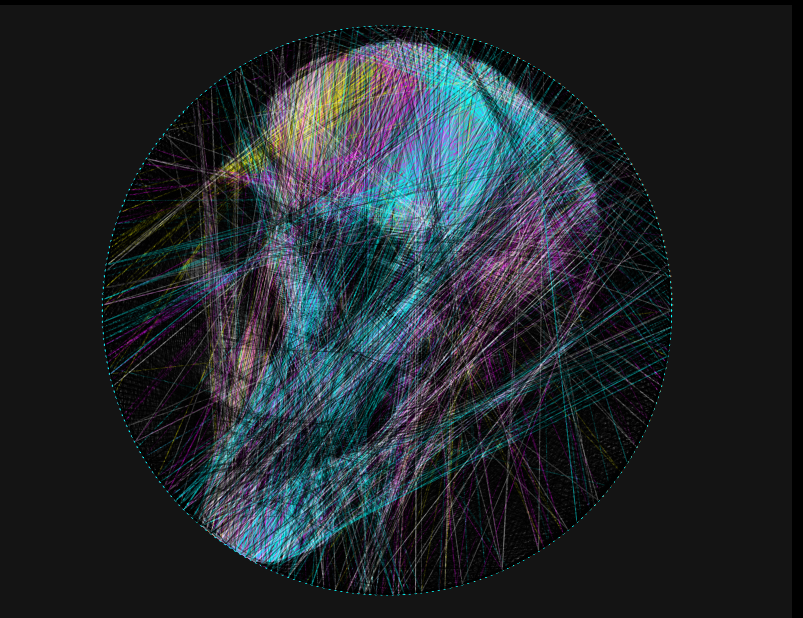
One clear example is Petros Vrellis's 2016 project A new way to knit, which describes a system that takes a digital photograph and generates a thread-based path across anchor points (Petros Vrellis). That example matters because it shows what computers change and what they do not. A computer can search for a pattern path far faster than a human can, but the final image still depends on the same core idea: building a picture through many straight thread connections between fixed points.
That distinction also helps explain modern string art generators. A site such as StringArt.cc currently describes a workflow where you upload a photo, choose settings, generate a pattern, and download it. That is not the same thing as replacing the craft. It is a digital way to produce the pattern logic that a maker can then use as a starting point.
Final Thought
String art is easiest to appreciate once you stop treating it as a visual trick.
It is a real craft with a clear structure, a credible historical lineage, simple physical materials, and a surprisingly flexible relationship with geometry. It can stay fully handmade, or it can move into digital tools that help generate patterns from images. Either way, the idea at the center remains the same: thread, fixed points, and a picture assembled one connection at a time.
If you want the classic experience, start with a small handmade design and learn how the lines behave. If you want to explore the digital side first, StringArt.cc is a practical place to generate a pattern from a photo and see how the concept works in a modern format.